Wednesday, July 26, 2006

“Secrets” a Radio 4 inspired monologue

I grew up listening to Radio 4 plays in the afternoons, being swept away by images created entirely by voices and a few (fairly low budget) sound effects. It engaged my imagination in more active and less directed way than television.

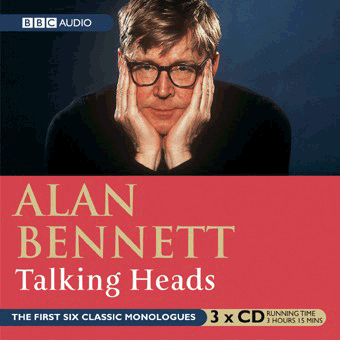
Although I enjoyed the normal plays, my preference was for stories read aloud or for the monologue. The definitive monologues in my view were by Alan Bennett’s “Talking Heads” where a single voice would paint a life while seeming simply to talk to you in an unstructured way.

I don’t normally write monologues – it’s not a form that lends itself to erotica but the other day I was staring at the screen of my laptop, waiting for my fingers to produce some words, when a voice in my head said “We all have secrets. You have one don’t you” and I knew I was listening to an echo from Radio 4 bouncing off my on-going obsession with secrecy and disclosure and what they do to us.

I listened to the woman speaking in my head, my fingers moved and “Secrets” appeared on the screen. It’s not particularly erotic but it does have a noir-ish tension that to me smells of sex the way that pubs always smell of smoke and spilled beer.

When I read it over I realized that somehow this short piece had pulled a lot of my emotions around secrets onto the page in a way that feels dynamic and yet has no real dialogue and almost no action. I think that this is because monologues speak to us directly, with no distractions of detail and context and make us engage with them in a way that is almost hypnotic.

The text of “Secrets” is below. If hope you enjoy it. I’d love to hear whether this speaks to your experience of secrets and what you think about this kind of monlogue.

Secrets

© Mike Kimera 2006. All rights reserved. Do not reproduce without written permission from mikekimera@yahoo.co.uk

We all have secrets. You have one don’t you? Don’t look so shocked. You’re in your forties. You have a ring on your finger. My guess is that you’ve been married a good long while now. You look like a nice person. I’ll bet you’re good with kids and animals and so on. So, seeing all that, I know you have to have a secret.

You don’t even have to think about it do you? I can see it in your face. It’s there, just below the surface of your mind, pecking at you like a chick trying to hatch, that thing that you know that your wife doesn’t, the one that would change everything, the one that you desperately hope doesn’t define who you really are.

No. Don’t get up. If you’d really wanted to get up you’d have done it when I sat opposite you in this cosy little booth, in this quiet little bar, where it feels like midnight even when it’s noon outside. Stay. Finish your drink. Let me tell you more about secrets.

Well that sat you down fast enough. Who’d have thought that a cute little thing like me could make a big man like you sit? Amazing what producing a brown envelope and a smile can do.

Do you know you’re holding your breathe? I’ve been told that men feel it in their balls- the anticipation of being caught. You’re wondering what I know and what I can prove and whether there is hope for you in the gap between the two.

But I bet that some small part of you, possibly even the part that you think of as “really” you, is more relieved than afraid.

People start out thinking that the hardest thing about a secret is keeping it. But someone like you, someone who’s had a secret for a while, someone who’s learnt that they can smile and lie and not get caught, you know that the hard part is that, in the end, the secret keeps you.

You’re good at this. By now lots of guys would’ve started to speak. Started to deny or threaten or even plead. But you’re sitting there silent because, speech, any speech at all, might give you away. I bet you’d be a real good poker player, except I suspect you don’t like to gamble unless you have to.

You know, the sad thing is that most guys, right up to the moment that they’re caught, don’t really know what their secret is. Oh they think they know. They think that’s it’s the mistress that they slip it to when they can’t face going home, or the whores they buy when they’re away on business, or the preferences that they only reveal through their (highly traceable) choice of on-line porn.

No. Don’t relax, not yet, I didn’t say that your secret was like that. Because we both know that the real secret is about who you’ve become.

Do you do that a lot, turn your wedding ring between finger and thumb? I bet you do. I bet you know why too. It’s because you love your wife. And you want her to love you. But even when she looks in your eyes and says she loves you, when she opens her legs and welcomes you in, when she comforts you on the nights you can’t sleep, you know she doesn’t love you. She can’t love you because she doesn’t really know you. If she knew who you really are then she’d know the secret and then what?

What do I want? That’s what you say when you finally decide to speak? Nice move. Let’s stop talking about you and talk about me instead. Nope. That’s not going to happen. This isn’t about what I want. This is all about you and your secret.

Do remember what it was like before the secret? When your wife trusted you and you knew you deserved it? Then, if she was sad, you knew it wasn’t your fault. If you made her happy you knew her joy wasn’t tainted by lies. You were happy then.

Those nights when you can’t sleep no matter how tired you are, the ones when you lie awake thinking and hope that she won’t notice. Think about what’s really keeping you awake. With some men it would be the fear of discovery. Not you though. You’re careful. Very, very careful. But you’re still afraid. You’re afraid that somehow, at some level beyond facts and logic, she already knows. You’re afraid that she is also pretending. You think about it don’t you? What it will be like when the kids have gone and there’s just the two of you, alone in the house except for the secret that neither of you mentions.

Tears. Good. I hoped for tears.

I cried when this happened to me. When I was liberated from my secret.

The envelope is empty by the way.

What happens next is up to you. I think you’re brave enough to break free of your secret. I hope so.

If you do, I ask only one thing: find someone who needs this envelope, needs it as badly as you did, and give it to them.

Tuesday, July 18, 2006

“The Last Taboo” – a transcription story

Most of the time, writing a story is a lengthy process for me, involving multiple drafts, maybe an outline, perhaps some research, or just the time to let an idea or a character or an image mature.

But every now and again a story will arrive in my head almost fully formed. Writing it feels more like transcribing something that is being read aloud in my mind.

Recently I’ve had one of these transcription stories, “The Last Taboo” published on the ERWA and I’d like to talk about it a little.

One of the things I’ve noticed about these “transcription” stories is that they are often in the first person and told in the voice of a character. It’s as if they are speaking in my head. Sometimes I find myself listening, wondering what they will say next.

“The Last Taboo” is told from the point of view of “Fat Frank”. All I knew about Frank when I started to write was that he enjoyed having sex with his wife. I let Frank talk and a picture built up of an introspective man who (just about) manages to be one of the lads but whose heart isn’t really in it.

I became curious about the kind of woman he would love and what sex between them would be like. I knew there had to more to it than just lust. She would have to value his introspection but not mirror it. I also knew that there would be something in the sex that would spark the imagination.

Yet it is misleading when I say I knew these things. Certainly I know them now, but as I wrote, it seemed to me that I learnt these things only as Frank shared them with me.

The story took a couple of hours to make first draft and then maybe an hour more to finish. Finishing with these kinds of stories largely consists of reading the story aloud and listening for the things that aren’t true to the voice of the character or that would pass in day to day speech but would grate upon a reader’s sensibilities.

One of the problems with these transcription stories is that, when they are finished, I have great difficulty knowing if they are any good or not. I’ve had too little time to evaluate them. To me they always seem “true” but I have no idea if they are hot or if they will speak to the experience of others.

“The Last Taboo” got good feedback on the ERWA list and was selected for the ERWA site that month, so I figured that it had worked as a story.

Two things told me that it had done more than that. The first was that ERWA put the story in their Treasure Chest section. You’ll find it here.

The second was the email the story attracted. At the same time that “The Last Taboo” was posted I posted “Brave Enough To Cry” – a story it had taken me over a year to put together in fits and starts of activity. I was very pleased when two people took the time to write to me and tell me that they enjoyed it. “The Last Taboo” got eight comments from readers. Now this is a story that has very little actual sex in it and yet people liked it because it either reflected their own secret lives or it depicted a life they wished to have.

I’m still not sure to make of all of this. “The Last Taboo” is not autobiography but it came from somewhere in my head and strikes a chord with people I’ve never met. This points to one of the most exciting and the most demoralizing things about writing: effort is not enough, talent is not enough – to have impact writing has to capture a truth about our lives as we think they are, as we would like them to be or as we fear they might become.

When I write, these truths are not something I create, they are something that I always hunt and only sometimes capture.

Tuesday, July 04, 2006

700 US Soldiers dead, 2,500 Iraqi Policemen dead, 12,000 Iraqi civilians dead - all in the past 12 months

Most of the time all that differs between BBC World and CNN is the grammar.

Today BBC world has been flashing numbers under interviews about Iraq for the past hour or so.

They put it in this sequence

IRAQ DEATH TOLL IN THE PAST YEAR

12,000 IRAQI CIVILIANS KILLED

2,5000 IRAQI POLICE KILLED

700 AMERICAN SOLIDIERS KILLED

And the numbers are rising.

Taking out Hussain unleashed sectarian violence.

Taking out the local al-Qaeda leader has had little or no impact.

I remember the grief of 2001. The disbelief. The incredulity at the sheer numbers of dead.

Even so, I went to remind myself September_11,_2001_attacks

2,986 people died that day as a result of a terrorist attack

That's less than number of US soldiers and Iragi policemen who were killed this year.

Hurrican Katrina killed 1,836. That's less than the number of Iraqi police who died this year.

In Afghnistan, as of June 30, 2006, there have been 396 coalition deaths during Operation Enduring Freedom — 308 American, 18 German, 17 Spanish, 16 Canadian, 12
British, 7 French, 6 Italians, 4 Romanians, 3 Danish, 2 Swedish, 1 Australian, 1 Norwegian, and 1 Portuguese.

I'm not trying to play a this-is-worse-than-that game based on numbers.

I'm only trying to set a scale for the death.

So...

It's Independence Day today.

If I was a praying man, I'd pray that someone will guide America through the dreadful, heart-aching path they must walk in Iraq and
Afghanistan and find a way to make the death toll smaller for everyone next year.

As an athiest, all I can do is make a noise about the numbers and not let any of us get so used to the conflict that we think any of this is normal.

Friday, June 30, 2006

Writing, Reading and Learning from Mr. Patterson

The stock advice to people who want to improve their writing is that they should read more.

I spent the first forty or so years of my life reading so much that it came to seem presumptuous to put pen to paper (or fingers to the key board – I long ago gave up pen and ink.

Over time, the desire to write somehow became the need to write and I decided that, no matter how poor my attempts seemed compared to writers that I admired, I was going to write anyway.

I’ve been writing for a few years now and I’ve learned some surprising things.

Writing, when I do it as well as I can, is even more fun than reading. It absorbs me totally. There is nothing else that I want at that moment than to write.

Having written means a lot less than the act of writing. Once a story is complete and published (web or print) it’s no longer really mine. At best, the story is like an old lover for whom you have affection but with whom you are no longer intimate. You know each other well but you’ve both moved on. Neither of you are who you were when you were together. At worst the story becomes an ex-colleague that you discover rather belatedly, you never really liked and are glad not to have to spend time with.

To beware of the appeal of the next story, the one that is nudging your imagination, rubbing itself against your ankles and curling its tail around your calf to convince you that you should ditch the half-completed tale that is anyway dying beneath your fingers and move on to something new and fresh and eager. It sometimes turns out to be sweet but more often deserts you before your relationship is consummated in print and leaving you regretting the tale you heartlessly abandoned and to which you now hesitate to return.

That the more you write, the less you know about yourself and the more you know about others. You know more about others because writing fiction demands that you look at the world through many eyes. To wrestle the story onto the page you must live behind those eyes, see what they see, feel what it is to be them. I find that that kind of writing decreases my eagerness to judge. You know less about yourself because you become aware of the vast tracts of unvisited landscape you imagination and perhaps the you that is really you, inhabits and you know that you cannot map it all. The landscape it too large and its attributes are not fixed and you wonder how, if you do not know yourself, others can possibly think that they know you?

Trying to write changes how you read. You see things clearly that, as a non-writing reader, were no more than fleeting impressions. You were perhaps always aware of the writer’s voice or power of visualisation or gift for dialogue but I you probably didn’t find yourself looking at the changes of tense, the modes of exposition, the choice of whether or not to follow the rules of grammar and punctuation.

This last is probably why writers are advised to read. Have you every seen dancers working out choreography? One will try a move; another will copy it and add a step or two. The dancers feed off each other. You can see the eager “I wanna try that” response to the new and the clever and the respect for the perfectly timed and exercise standard. Now writers are not performance artists but they can still feed of on another’s work, still have that “Wow, I want to try that” reaction.

Let me give you an example.

I've just finished James Patterson's "Maximum Ride: The Angel Experiment".

If you know Patterson then it's probably for his thrillers: ingenious, violent, fast-paced, that translate well to film.

"Maximum Ride" is one of his books for teens. Still a thriller. Not so violent but the violence that there is not glamorised. Very fast-paced.

It's about a group of kids with wings who have escaped from the lab they were mutated in and who are being chased by were-wolf like Erasers".

Yes, I know. This isn’t the kind of plot that they put on the Eng Lit courses but I think they should.

Listen to the first sentence of Chapter 1 (all the text quoted is also shown on Amazon as copyrighted material)

"The funny thing about facing imminent death is that it snaps everything else into perspective".

Now that grabs the attention

But the next line sets up the book

"Take right now, for instance."

That's what the book does - it takes right now and keeps you right there where everything is happening. Plot provides perspective. Reflection is a by-product of action and yet is the abiding memory of the book

Then comes the narrow focus - you're in someone's head - line, in italics to note the change in view.

Run! Come on, run. You know you can do it

So what does it feel like?

"I gulped deep lungfuls of air. My brain was on hyperdrive. I was racing for my life. My one goal was to escape. Nothing else mattered"

See how we go from reflection to exhortation, to close focus physicality in a couple of paragraphs? So now it's time to add some style and hook the teen reader (and the late developers like me) - let's get glib but likeable and stress what "nothing else matters" means and what "snapping into perspective" feels like.

"My arms being scratched to ribbons from a briar I'd run through? No biggie. My bare feet hitting every sharp rock, rough root, pointed stick? Not a problem. My lungs aching for air? I could deal. As long as I could put as much distance as possible between me and the Erasers."

So it's scary but you want to smile and you admire the bravery and subconsciously you register the lyrical value of "sharp rock, rough root and pointed stick" and you sniff intelligence.

But wait up - didn't we just hit a problem of exposition? What are those Erasers with a capital E? The next sentence takes care of that.

"Yeah. Erasers, mutants, half-men, half-wolves, usually armed, always bloodthirsty"

Nine words. That's all he needs to paint the scary baddy. The short phrases sound like you could spit them out while running. The "Yeah" builds character (witty, articulate) and subtly reassures that the baddy isn't going to be up to catching someone this street smart. Nine words for all that.

But we're not done yet. We have to link back the first line on perspective and keep things in the "take right now, for instance" mode. Patterson does it in two lines. The first one is:

"Right now, they were after me."

See the how it comes back to NOW and see how much more threatening "after me" is than "chasing me” - much less game, much more malice.

The second sentences ties everything back the beginning:

“See? That snaps everything into perspective."

Ok - no more quotes.

My point is - this is a fun, easy to read, rapidly paced, action book that makes you think, makes you like the players, and never ever has you skipping text.

As I read it's like have wind under your wings -you soar on Patterson's skill. As a would-be writer, I want to go back and take it apart and see how I could write like that. I want to play with fragments instead of sentences and set up patterns that no one but me will notice but which flavour the dish like salt on meat and I want not to use one single unnecessary word.

Thursday, June 29, 2006

What short fiction is all about

I've had an exciting day in a writerly sort of way - I was browsing the English books section of a bookstore in Zurich when I found "Runaway" which is Alice Munro's latest collection of short stories (That's her on the left).


Her last collection "Hateship, Friendship, Loveship, Marriage"came out in 2001 and I reread it last year. I even wrote a short review:

"Alice Munro is a long time favourite of mine. She writes short stories that have the impact of novels. She reconnects you to what it is to be human without any sentimentality but with a lot of truth and a dash of love and hope. I reread this collection this year and none of the nine stories have lost their savour. The last story in the collection “The Bear Came Over the Mountain” is probably one of the best short stories ever written. It looks at love, lust, betrayal, loyalty, memory and forgiveness and leaves you feeling understood and hopeful."

So I grabbed a tram to go across town to see "X-Men - The Last Stand" (what can I say- I'm a culture hound) and on my way I started to read Jonathan Franzen's introduction to Munro's collection. I almost missed the film (which, in retrospect would have been a small loss.) - Franzen knows what he's talking about (which is another way of saying that he and I agree on many thougs so he must be a man of great insight).

He explains what it is that sets short fiction apart as well as what it is that makes Munro one of the best practioners of the art. His style is witty and accessible but his content is sharp and perceptive.

He says that he likes short stories because they leave the author with no place to hide: "I like stories because it takes the best kind of talent to invent fresh characters and situations while telling the same story over and over. All fiction writers suffer from the condition of having nothing new to say, but story writers are the ones most abjectly prone to this condition. There is, again, no hiding. The craftiest old dogs, like Munro and William Trevor, don't even try."

This is something to chew on if, like me, you are a compulsive writer of short fiction. Especially in those moments when I find that I am YET AGAIN writing about guilt and lust and love and self-hate and the possiblity of redemption. It seems I may not be stuck in a rut. I may be just trying to get to the essence of the the thing. Getting to that essence may even by why I have to write.

And what is the essence?

Well I think Franzen sums it up when he says that it is difficult to summaruse a Munro story because "The only adequate summary of the text is the text itself."

That's it. That's want I want people to feel when they read what I've written - THE ONLY ADEQUATE SUMMARY OF THE TEXT IS THE TEXT ITSELF.

My writerly day was made complete when, after the ride back to (yet another) hotel room I went on-line and found that Franzen's review is available from the New York Time site.

I've given the link below. I recommend you read the article and think about what kind of writer you want to be.

And, of course, I recommend that you go out and buy "Runaway" and see for yourself what a master of the form can do.

Franzen's review

Monday, June 26, 2006

Oven Gloves and Sex


ERWA has a Writers list where we discuss all kinds of writerly things - anything from the technical side of writing through to aspects of publishing and being publsihed.

Recently one of the writers posted this link to what she described as a totallyembarassing ad: Harlequin Spice Link

Once the issue of oven gloves and sex was on the table we just couldn't
let is go and the whole thing spilled over into Parlor (ERWA's discuss-anything-and-everything list) like a pub
crawl with attitude.

But I'm afraid that the only emotion I could summon at the image of a
woman reading a romance book while wearing oven gloves was amusement -
apologies to those more able than I to summon a sense of outrage at the
continuation of the media's tendency to promote patronising images of
women - coy, guilty about sex but still wanting it, domesticated but
also sensual etc etc.

So then I started to think about the story possiblities (ok I was stuck
in yet another hotel room with nothing else to do - I shoul
d get a
life).

This piece of froth is my way of working the amusement out of my
system. I hope I manage to pass on a smile or two to you.

Enjoy.


"The G is silent" by Mike Kimera

© Mike Kimera 2006, all rights reserved.

Do not reproduce without written permission from mikekimera@yahoo.co.uk


It’s not really a fetish or anything. Anyway, I was so innocent back then that I thought that a fetish was some kind of Mediterranean cheese.

No, it was just that oven gloves seemed quite a sensible solution at the time.

I mean, I wanted to make Kevin happy but I also wanted to wait until we got married so using my hands to erm... “help him relax” seemed like a good compromise.

The thing was, when it came right down to it, I wasn't sure I actually wanted to touch him there. I mean I knew he washed it and everything, but I also knew that he peed out of it.

Kevin had sort of suggested, well actually pleaded is more like it, that I might want to kiss him there. He’d said lots of girls used their mouths like that. I told him straight out that I wasn’t going to let something he used to go to the toilet with anywhere near my mouth and that put an end to that.

Except I could feel his growing frustration - actually anyone who got close enough could see his growing frustration – and I knew I’d have to do something about it or he’d find a girl with lower standards of oral hygiene.

I decided to fix it during one of our Saturday night pizza and DVD sessions. My parents always went out to the movies on Saturday nights and Kevin would come round; I’d put a pizza in the oven and we’d eat it curled up on the couch watching a video.

I knew that what was about to happen would be embarrassing, so I waited until Kevin had a slice of pizza in his mouth (he always tries to push a whole slice in in one go –which was a good thing for once as it meant that he couldn’t talk) and then I put my hand on his crotch and said: “I know that things have been getting harder and I want to help…”

I had to stop for a moment and pat Kevin on the back until he stopped choking, “But I don’t want you to get any wild ideas, Kevin Crouch. I’m just going to give you a helping hand.”

I knew if I didn’t keep moving I’d lose my nerve, so I grabbed hold of the Kevin’s zip and pulled it down. I’d half expected a sort of jack-in-the-box effect but nothing sprang out. It took me a few seconds of fumbling and a little help from Kevin before I could negotiate the Y fronts and see his thing.

That was when the doubt started to form. Kevin’s penis (the word felt strange even said silently in my head) was soft and a little sleepy when we started and looked completely alien resting there against his testicles. Did everyone have testicles that big? What was all that hair for and wouldn’t it stick in the teeth? Why was the skin of the penis darker than the rest of him and was the foreskin supposed to fold over the end like an ugly, mutated bluebell? I bent closer to look at it, it got harder and looked even worse, what with all those swollen veins and the odd bruised-purple colour of the tip and little dew-drop of sticky stuff that appear at the slit.

What finally put me off was the heat. I hadn’t expected the skin to be so hot. It just felt wrong in my hand.

The oven-glove I’d used to bring the pizza tray over with was still on the coffee table. Probably I was a little panicked but I wanted to continue helping Kevin and I knew the heat would freak me out so I it seemed natural to put on the glove to help me cope.

“What are you doing?” Kevin said. His tone suggested that he hadn’t followed my logic and thought I’d gone insane.

“Do you want me to stop?” I snapped. I loved Kevin a lot but that didn’t mean I was going to put up with criticism.

“No. Don’t stop. Please.”

I liked the “please”. It made me feel warm inside.

With the oven glove on, it all seemed more manageable somehow. It was harder work than I expected. It took so long that I had to swap hands – it was a good job the glove was ambidextrous – but it was quite exciting at the end. Kevin had his eyes closed and his face scrunched up like I was hurting him but I knew that I wasn’t. I knew he was excited and a little desperate and that I had his complete attention. I decided I liked that. I liked that a lot.

Kevin finished with a stifled groan and four or five spurts of thick messy smelly goo that meant that the oven glove would have to go straight in the washer – still, at least I didn’t get any on my fingers.

When I came back from the washer, Kevin kissed me and told me how happy I’d made him and what a good girl I was and how lucky he was and then he kissed me some more and the next thing I knew I needed to use the other oven glove.

We’ve been married for eighteen months now and I’ve learned a lot more about how to make Kevin happy and how to make myself happy in the process, but once in a while, on a Saturday night, we’ll still use the oven gloves. Kevin made me a pair of paper oven gloves for our first anniversary. He couldn’t have come up with a better gift. After all, we both know the G is silent.